November 6, 2026
Steel H-Pillar Sourcing: How Hot-Formed Body Structures Are Changing Buyer Decisions
A buyer-focused look at steel H-pillar design and sourcing as hot-formed B-pillar inner panels, A-pillar plates, and bumper beams move toward 1500 MPa-class martensitic steels. Covers what the shift means for tooling, dimensional control, validation, and supplier questions.
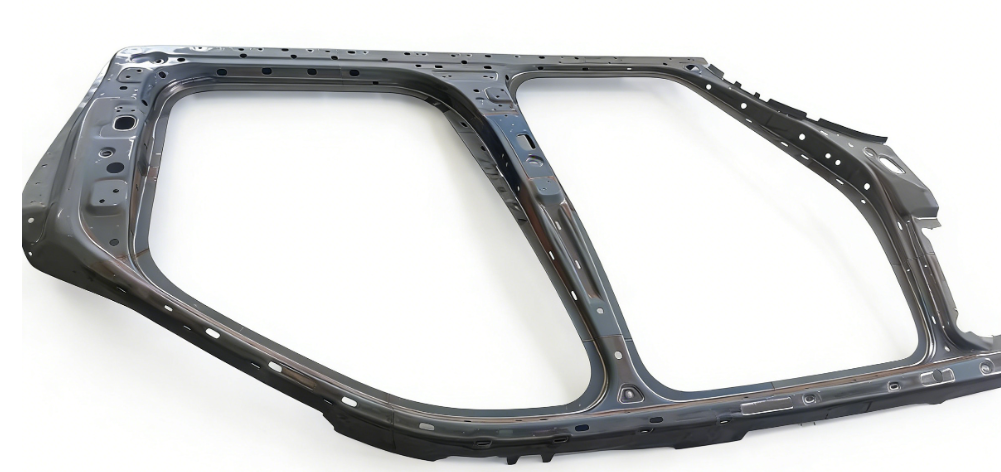
Why the steel H-pillar is back on the sourcing agenda
The steel H-pillar — the reinforced body structure formed by the B-pillar and its surrounding connections — sits at the center of two pressures that rarely pull in the same direction: crash performance and mass reduction. For years, the default answer was to add thickness or add a patch. That answer is getting harder to defend as platforms add side-impact and roof-crush requirements while chasing range and efficiency targets.
What has changed is not the pillar concept. It is the material and process envelope around it. Hot-formed steel body components now routinely reach tensile strength above 1500 MPa, with martensitic transformation doing the strengthening rather than alloy content alone. That shifts the buyer's question from "how thick should the pillar be" to "which forming route, which dimensional control, and which validation evidence do I need to trust the part in a body-in-white (BIW) build?"
This article treats that shift as a sourcing and engineering decision, not a materials lecture. It separates what is observable in the process from what remains a supplier-specific claim, and it gives buyers a set of questions that surface the difference quickly.
What the H-pillar actually does, and where hot forming fits
The H-pillar is a load path, not a single part. In a side impact, the B-pillar and its reinforcements must resist intrusion into the occupant compartment while transferring force into the rocker, roof rail, and floor structure. In a rollover, the same structure contributes to roof-crush resistance. In a frontal or offset event, the A-pillar and hinge-area geometry carry a different but related role.
Hot forming (also called press hardening) fits this load path because it produces a martensitic microstructure in a single forming cycle. The reference process for a hot-formed B-pillar inner panel describes heating, quenching, high-pressure forming, and controlled cooling, with die positioning used to hold geometry during the phase change. The practical consequence is high strength with reduced springback compared with conventional cold stamping of the same grade.
That does not make hot forming automatically correct for every pillar. It makes it a candidate where the design needs high strength in a thin section and where dimensional consistency at the BIW interface matters. Buyers should treat the process as a design enabler with its own cost and control profile, not as a universal upgrade.
The trade-off table buyers should keep open during evaluation
The comparison below reflects the process characteristics described in the supplied product information and general hot-forming practice. It is a decision aid, not a specification sheet — final values depend on the part design, steel grade, tool, and supplier validation.
Decision factor | Conventional cold-stamped pillar | Hot-formed pillar (martensitic) | What it means for sourcing |
|---|---|---|---|
Strength route | Grade and thickness driven | Martensitic transformation during forming | Ask for the grade, the process window, and the measured tensile result — not just the headline number |
Springback | Present; compensated in tooling | Reduced by forming in the austenitic state and quenching in the die | Confirm how dimensional capability is demonstrated on the actual part, not the process in general |
Dimensional control | Tool and process dependent | Die positioning and cooling control are critical | Request a capability study on key BIW interfaces and check datum strategy |
Tooling and energy | Lower tooling complexity, higher part count per tool life in some cases | Heating, quenching, and cooled dies add process cost | Model total cost including scrap, rework, and fixture adjustment at the OEM line |
Coating and corrosion | Depends on substrate and coating | Surface condition and coating adhesion must be controlled after quenching | Ask for coating adhesion and corrosion test evidence for the specific finish offered |
Joining and assembly | Mature weld and adhesive schedules | High-strength martensitic steel can affect weld and spot-joining windows | Confirm joining validation with the actual mating materials, not a generic data sheet |
Reading a 1500 MPa claim correctly
A tensile strength above 1500 MPa is a strong statement, but it is not a complete one. Buyers should establish four things before treating it as a decision input.
Where the number comes from. Is it a minimum, a typical value, or a best-case result? The supplied product information states tensile strength reaches over 1500 MPa for the hot-formed B-pillar inner panel; a buyer should ask for the test method, sampling location, and whether the value is a specification limit or an observed result.
Which part it applies to. A-pillar inner plates, B-pillar inner panels, and bumper beams are different geometries with different forming severity. Strength claims should be tied to the specific part number and drawing.
What happens at the heat-affected zone. Welding and laser cutting can locally alter the martensitic structure. The relevant question is not only base-metal strength but the strength and ductility retained in the joint and trim regions.
How it is verified in production. Hardness mapping, coupon testing frequency, and traceability by heat lot tell you whether the claim is a process capability or a one-time lab result.
None of this argues against high-strength hot-formed pillars. It argues for treating the number as the start of a verification conversation, which is exactly what a competent supplier should expect.
Dimensional control: the quiet driver of BIW fit
In practice, many hot-formed pillar programs fail not on strength but on fit. A B-pillar inner panel that is a fraction of a millimeter out at a hinge or rocker interface can create rework at the OEM line, and line-side rework is expensive in a way that is invisible in the piece price.
The supplied product information for the hot-formed A-pillar inner plate cites a dimensional deviation of ≤0.2 mm. That is a useful reference point, but buyers should ask how it is measured: over what feature, with what fixture, at what point in the process, and across how many parts. A tolerance statement without a measurement plan is a marketing line. A tolerance statement with a capability study, a datum scheme, and a sampling plan is a manufacturing commitment.
Three practical checks help:
Datum continuity. Confirm the supplier's datum scheme matches the OEM's checking fixture and the BIW assembly sequence.
Springback compensation evidence. Ask how the die was compensated and how the compensation was verified after quenching, not only after forming.
Trim and pierce strategy. Post-quench laser cutting or hard trimming affects edge quality and dimensional repeatability at mating surfaces.
Where the pillar sits in the lightweighting conversation
Lightweighting debates often frame steel and aluminum as competitors. For the H-pillar, the more useful framing is a mixed-material body where each zone uses the material and process that meets its load case at acceptable cost. Hot-formed steel pillars remain attractive where side-impact intrusion and roof strength dominate, while aluminum and extruded structures often win in other zones.
For buyers, the implication is that pillar sourcing should be evaluated against the whole body architecture rather than in isolation. A hot-formed B-pillar inner panel that is well integrated with the rocker and roof rail can allow thinner sections elsewhere. A pillar optimized alone may simply move mass and cost into the joints.
Adjacent components follow the same logic. Hot-formed front and rear bumper beams, for example, are described in the supplied product information as energy-absorbing and force-transmitting structures with tensile strength above 1500 MPa. Whether that is the right choice depends on the crash strategy: a beam that is very stiff may transfer more load into the rails, which then need their own reinforcement. The system, not the part, is the unit of optimization.
Supplier evaluation: questions that separate capability from claims
Most suppliers can describe hot forming. Fewer can show the process controls that make it repeatable. The following questions are designed to be answerable with documents rather than assurances.
Process and metallurgy
What steel grade and coating are used, and what is the specified process window for heating, transfer time, and die quenching?
How is martensitic transformation verified — hardness mapping, metallography, or both — and at what frequency?
How are heat-affected zones at welds and laser-cut edges characterized?
Quality and traceability
Can you provide a dimensional capability study on the specific part and datum scheme?
What is the sampling plan for mechanical properties, and how are results traced to heat lots and production dates?
How are non-conforming parts contained, and what is the rework policy for dimensional deviations?
Program and commercial fit
Which part numbers in your portfolio are closest to our geometry, and what tooling would be new versus adapted?
What is the validation plan and timeline for PPAP or equivalent approval, stated in your own process terms?
How do you handle engineering changes after tooling is frozen?
Buyers should also ask for the supplier's own limits. A supplier that can articulate where hot forming is not the right answer is usually more credible than one that applies it to every pillar inquiry.
Warning signs in a pillar quotation
Certain patterns in a quote or technical response should slow a buyer down.
Strength claims without part numbers. A blanket "1500 MPa" across an entire catalog usually means the number is a material datasheet value, not a verified part result.
Tolerance claims without a measurement plan. Numbers like ≤0.2 mm are meaningful only with a defined feature, fixture, and sample size.
No discussion of joining. A pillar is joined to other structures; a supplier that does not raise weld or adhesive validation has not thought through the BIW interface.
Coating claims without test evidence. Corrosion and coating adhesion after quenching are process-sensitive and should be supported by test reports for the offered finish.
Unclear change control. Hot-formed tooling is expensive to modify; vague answers on engineering changes become costly later.
A practical next step for buyers
The most useful first move is not a price request. It is a short technical package: the pillar drawing with datum scheme, the load cases the part must meet, the mating materials at each joint, the target annual volume, and the program timing. Send that package to two or three suppliers and ask each to respond with a process route, a dimensional control plan, a validation outline, and a list of assumptions.
Comparing those responses side by side will reveal more about capability than any brochure. It also gives the buyer a defensible basis for the commercial conversation that follows, because the assumptions are on the table before the price is.
For buyers evaluating hot-formed body frame components, the supplied product information covers a hot-formed B-pillar inner panel (LTWT030), a hot-formed A-pillar inner plate (LTWT028), and hot-formed front and rear bumper beams (LTWT029), with custom specifications available on request. Those part numbers are a starting point for a technical discussion, not a substitute for the validation evidence described above.