September 18, 2026
Integrated Door Rings: How One-Piece Designs Are Making Vehicles Safer and Lighter
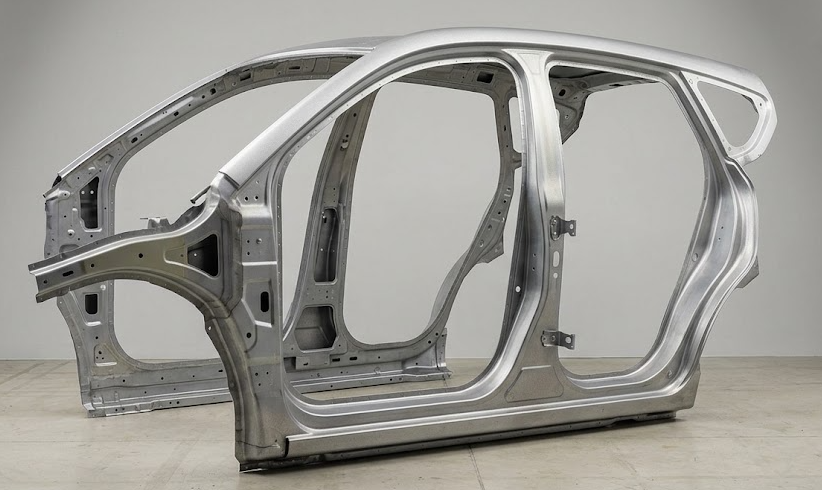
Table of Contents
Introduction: A Structural Revolution in Automotive Design
Reducing Weight Without Sacrificing Strength
Improving Crash Safety Through Integrated Design
Manufacturing Advancements: Hot Stamping and Tailor-Welded Blanks
The Future: Double-Door Rings and Advanced Materials
Frequently Asked Questions (FAQ)
1. Introduction: A Structural Revolution in Automotive Design
The side of a car is one of its most complex and safety-critical areas. Traditionally, it was built by welding together multiple individual parts: the A-pillar, B-pillar, roof rail, and sill. Each part had to be stamped, stored, and then assembled with dozens of spot welds.
The integrated door ring changes this entirely.
Also known as a "door ring" or "phs-door ring," this technology replaces a collection of separate components with a single, integrated structure that wraps around the front or rear door opening . It's a paradigm shift that brings significant benefits in safety, weight, and manufacturing efficiency.
2. Reducing Weight Without Sacrificing Strength
The most immediate benefit of an integrated door ring is weight reduction. By consolidating multiple parts into one, automakers can reduce the overall part count and eliminate the overlapping material and redundant reinforcements that come with traditional designs.
The numbers are significant. Research indicates that door ring structures can contribute to a 10–20% mass reduction for the entire body-in-white . This weight saving is achieved through:
Optimized material distribution: Using tailor-welded blanks (blanks with different thicknesses welded together) allows engineers to put thicker, stronger steel exactly where it's needed and thinner material where it's not .
Elimination of overlapping joints: Traditional designs require overlapping sheets at weld points, adding unnecessary mass. An integrated ring removes this waste .
Reduced part count: Fewer parts mean less total metal mass per vehicle.
This weight reduction translates directly to better fuel efficiency and lower emissions. For a conventional combustion vehicle, a 100 kg weight reduction can save about 0.7 liters of fuel per 100 kilometers, cutting roughly 4 tons of CO₂ over the vehicle's lifetime . While a door ring alone doesn't save 100 kg, it is a substantial contributor to overall lightweighting efforts.
3. Improving Crash Safety Through Integrated Design
Safety is the other side of the coin. An integrated door ring doesn't just save weight; it creates a stronger, more robust safety cell.
The key is its continuous, seamless structure. In a traditional design, a crash load must travel from one welded part to the next, with each joint being a potential point of failure. An integrated door ring creates a continuous load path that can channel crash energy more effectively around the passenger compartment.
Advancements in material science make this possible. Door rings often use press-hardened steel (PHS) , also known as hot-stamped steel. This material achieves extremely high strength (up to 2000 MPa in some areas) while maintaining formability . By using materials with different strengths in different zones of a single door ring—for example, 1000 MPa steel with increased ductility in the A-pillar area and a 2000 MPa patch plate in the roof frame —engineers can tune the part for both intrusion resistance and energy absorption.
The result is a vehicle that performs better in side impacts and rollover events, with improved cabin integrity for occupant protection.
4. Manufacturing Advancements: Hot Stamping and Tailor-Welded Blanks
Making a single, large, and extremely strong door ring is not simple. It requires advanced manufacturing techniques.
4.1 Hot Stamping (Press Hardening)
Hot stamping involves heating steel blanks to over 900°C, then forming and quenching them in a cooled die in seconds. This process creates ultra-high-strength steel parts with minimal springback, ensuring dimensional accuracy . For a large part like a door ring, it also allows complex geometries to be formed in one shot.
4.2 Tailor-Welded Blanks (TWB)
Not all parts of a door ring need to be the same strength or thickness. Tailor-welded blanks are created by laser-welding different steel sheets together before the hot stamping process . This allows engineers to place 2000 MPa steel at the roof rail where rollover protection is critical, and a more ductile, less thick steel near the sill where energy absorption is more important.
4.3 Overcoming Manufacturing Challenges
The hot stamping of an integrated door ring can present challenges like wrinkling and thinning, particularly in areas with complex geometry . Advanced mold technologies, such as anti-convex die structures and in-die hydraulic cylinders, have been developed to address these issues, resulting in a production pass rate exceeding 98.3% .
5. The Future: Double-Door Rings and Advanced Materials
The technology is evolving rapidly. One major innovation is the double-door ring, which integrates both the front and rear door openings into a single, larger structure . This further reduces part count and assembly complexity while maintaining or even improving structural performance.
Looking further ahead, the industry is exploring materials beyond steel. Carbon fiber reinforced plastic (CFRP) components, which can offer similar strength at a fraction of the weight, are being developed for niche and high-performance applications . However, for mainstream, high-volume production, the integrated steel door ring—with its combination of cost-effectiveness, manufacturability, and performance—is set to remain the dominant solution for years to come.
6. Frequently Asked Questions (FAQ)
Q: What is a door ring?
A: A door ring is a single, integrated structural component that forms the frame around a vehicle's front or rear door opening. It combines several parts (A-pillar, B-pillar, roof rail, sill) that were traditionally welded together from multiple pieces.
Q: How does an integrated door ring improve safety?
A: It creates a continuous, seamless load path that channels crash energy more effectively around the passenger compartment, improving intrusion resistance in side and rollover crashes.
Q: How much weight can a door ring save?
A: Door ring structures are a key enabler of lightweight body-in-white designs, contributing to a 10–20% mass reduction in the overall body structure .
Q: What materials are used in door rings?
A: Door rings are typically made from high-strength steel using a hot stamping (press hardening) process. Different steel grades and thicknesses can be combined in a single part using tailor-welded blanks.
Q: What is a double-door ring?
A: A double-door ring is a next-generation design that integrates both the front and rear door openings into one monolithic structure, further reducing part count and weight .
Q: Can I get an integrated door ring for my existing car?
A: No. This is a structural, manufacturing-level technology. It is integrated into the vehicle's body-in-white during production and cannot be retrofitted.