July 10, 2026
Collision energy absorption optimization design of aluminum alloy anti-collision beams: integrated application of multi-cavity structure, variable cross-section design and hot air forming process
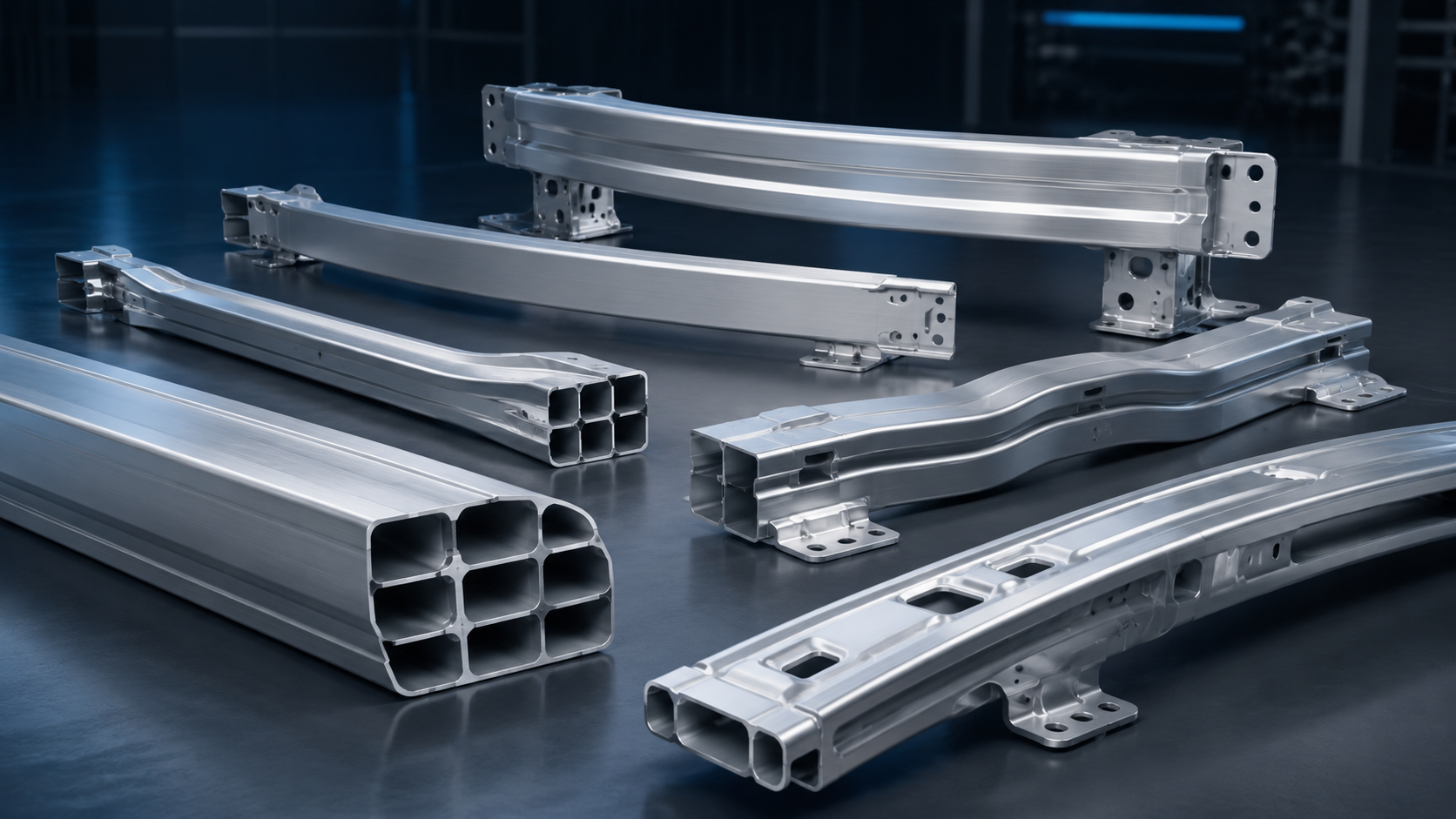
Table of Contents
1. Passive Safety Principle of Automotive Aluminum Alloy Bumper Beam
2. Advantages of Multi-Cavity Structure for Bumper Beam Energy Absorption
3. Energy Absorption Optimization of Variable Cross-Section Design
4. Hot Gas Forming Process Characteristics and Application Value
5. Performance Comparison of Different Bumper Beam Design Schemes
6. Comprehensive Design Strategy for Crash Energy Absorption
7. Industry FAQ
1. Passive Safety Principle of Automotive Aluminum Alloy Bumper Beam
Automotive passive safety systems focus on reducing collision damage during vehicle impact events.
The aluminum alloy bumper beam is the core bearing and energy-absorbing component of the vehicle front and rear protection structure.
Different from traditional steel bumper beams, aluminum alloy materials own lightweight characteristics while maintaining high structural strength.
Its core working mechanism is crash energy absorption. It converts instantaneous impact kinetic energy into structural deformation energy.
This design effectively protect the body chassis and passenger cabin from severe extrusion damage.
2. Advantages of Multi-Cavity Structure for Bumper Beam Energy Absorption
Single-cavity bumper beams are prone to sudden collapse during collisions, with unstable energy absorption effect.
The multi-cavity structure is the mainstream optimized design for modern aluminum alloy bumper beam.
2.1 Structural Mechanical Characteristics
The multi-cavity structure divides the internal space into multiple independent closed cavities. It improves overall structural rigidity.
Each cavity can deform progressively during impact, avoiding overall instantaneous structural failure.
2.2 Energy Absorption Performance Promotion
Multi-cavity layout realizes step-by-step crash energy absorption. It greatly improves the uniformity of force bearing.
It solves the problem of insufficient energy absorption of single-cavity beams under medium and low-speed collisions.
3. Energy Absorption Optimization of Variable Cross-Section Design
Fixed cross-section bumper beams cannot adapt to complex collision force changes. It has obvious performance limitations.
Variable cross-section design adjusts the wall thickness and cavity width along the beam length direction.
3.1 Design Core Logic
The stress concentration area adopts thickened cross-section to enhance impact resistance.
The auxiliary force area adopts thin-walled design to ensure lightweight and controlled deformation.
3.2 Practical Application Value
Variable cross-section structure makes the crash energy absorption process more controllable.
It avoids excessive local deformation or insufficient overall buffering in partial collision scenarios.
4. Hot Gas Forming Process Characteristics and Application Value
Hot gas forming is a advanced manufacturing process for high-precision aluminum alloy automotive structural parts.
Traditional cold stamping process cannot complete complex multi-cavity and variable cross-section integrated molding.
4.1 Process Principle
Hot gas forming heats the aluminum alloy blank to plastic state, then uses high-pressure gas for integral expansion molding.
The material fluidity is improved obviously, which suitable for complex curved and variable-section structures.
4.2 Performance Advantages of Formed Parts
Aluminum alloy bumper beam manufactured by hot gas forming has uniform wall thickness and no internal residual stress.
The structural consistency is far better than that of welded and spliced traditional processes.
5. Performance Comparison of Different Bumper Beam Design Schemes
The following industry standard test data intuitively reflects the performance differences of different bumper beam structures and processes.
Bumper Beam Scheme | Collision Energy Absorption Rate | Structural Deformation Uniformity | Weight (kg) | Structural Stability |
Steel Single-Cavity Fixed Section | 68.2% | Poor | 4.8 | General |
Aluminum Single-Cavity Hot Gas Forming | 75.6% | Medium | 3.2 | Good |
Aluminum Multi-Cavity + Variable Cross-Section + Hot Gas Forming | 89.3% | Excellent | 3.3 | Excellent |
The composite design scheme achieves the best balance of passive safety performance and lightweight effect.
6. Comprehensive Design Strategy for Crash Energy Absorption
To maximize the passive safety performance of aluminum alloy bumper beam, single structural optimization is not enough.
Designers need to combine multi-cavity structure, variable cross-section design and hot gas forming process comprehensively.
Multi-cavity structure guarantees overall energy absorption foundation. Variable cross-section realizes targeted stress adjustment.
Hot gas forming process ensures the integral molding precision and structural consistency of complex structures.
The three technologies coordinate with each other to solve the defects of low energy absorption and unstable deformation.
7. Industry FAQ
Q1: Why multi-cavity structure is better than single-cavity for aluminum bumper beam?
A1: Multi-cavity structure realizes progressive deformation and step-by-step crash energy absorption. It avoids sudden structural collapse and improves collision stability, which enhances vehicle passive safety.
Q2: What is the core advantage of variable cross-section design?
A2: It realizes differentiated stress bearing, strengthens weak areas, retains lightweight advantages, and makes energy absorption process more stable in different collision working conditions.
Q3: Why hot gas forming is required for complex aluminum bumper beam?
A3: Hot gas forming achieves integral molding of multi-cavity and variable cross-section structures. It eliminates welding gaps and residual stress, improving structural durability and precision.
Q4: How much performance improvement can composite design bring to passive safety?
A4: The comprehensive scheme increases energy absorption rate by more than 20% compared with traditional steel beams, and reduces body weight by about 30%, balancing safety and energy saving.