July 10, 2026
Automotive Lightweight Internal Pressure Forming Technology: Process Parameter Optimization and Wall Thinning Rate Control for Aluminum Alloy Tube Hydroforming
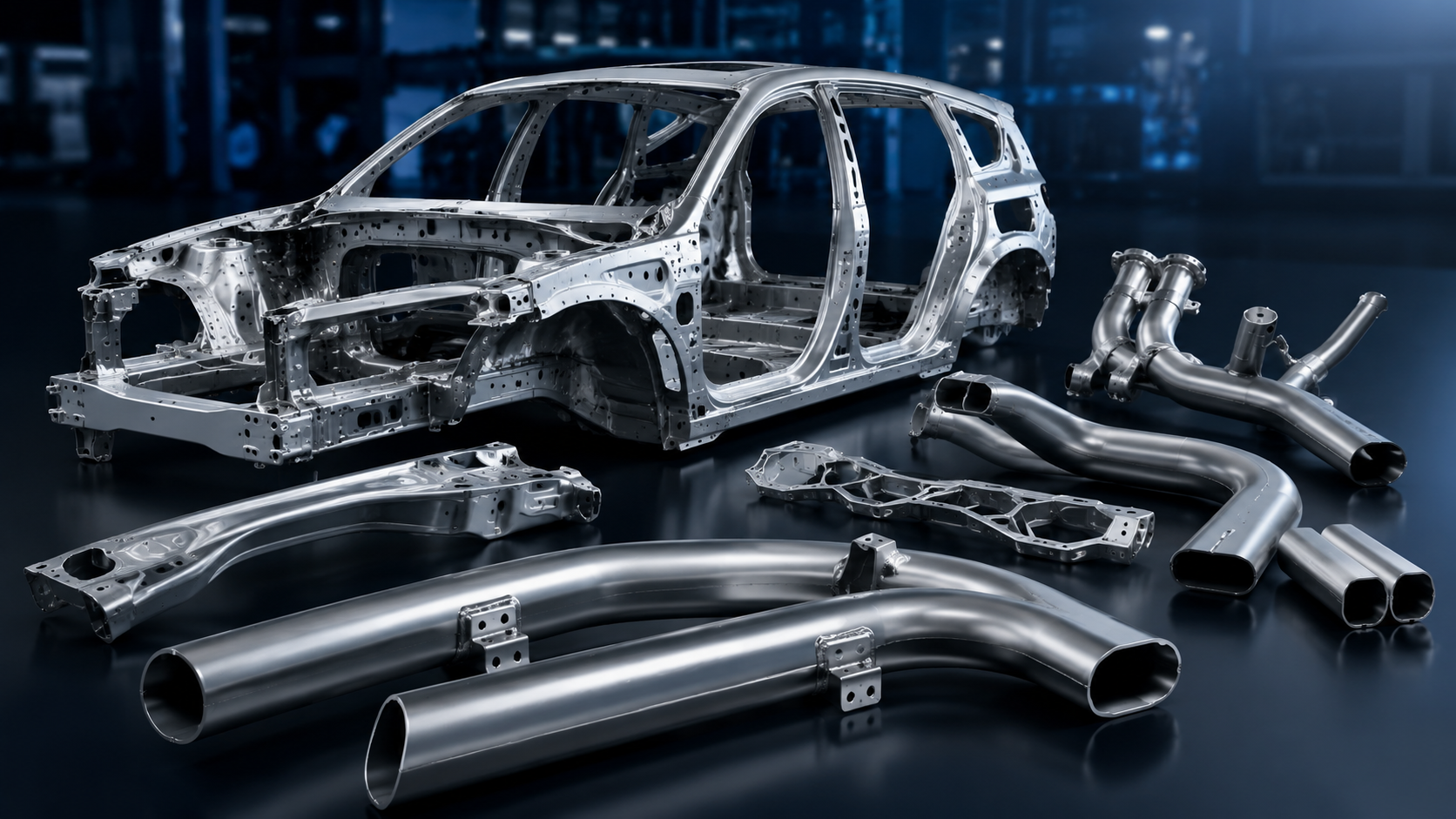
Table of Contents
1. Overview of Automotive Lightweight Development Trend
2. Internal Pressure Forming and Hydroforming Technical Principles
3. Key Process Parameters of Aluminum Alloy Tube Hydroforming
4. Wall Thinning Rate Control Data Comparison
5. Process Parameter Optimization Strategies
6. Industrial Application Value and Limitations
7. Industry Professional Q&A
1. Overview of Automotive Lightweight Development Trend
Automotive lightweight has become a core development direction for new energy and traditional fuel vehicles worldwide.
Reducing body weight effectively lowers energy consumption, improves driving range and enhances vehicle handling performance.
Aluminum alloy tube is the mainstream lightweight structural material, widely used in body frames and chassis parts.
Traditional stamping and bending processes cannot meet high-precision forming demands of complex aluminum tube structures.
So internal pressure forming and hydroforming processes are gradually becoming standard manufacturing solutions.
2. Internal Pressure Forming and Hydroforming Technical Principles
2.1 Internal Pressure Forming Core Mechanism
Internal pressure forming is a plastic forming technology that uses medium pressure to push material deformation.
It applies uniform internal pressure inside the closed tube blank to make the material fit the mold cavity evenly.
This method avoids local stress concentration caused by rigid die extrusion.
2.2 Aluminum Alloy Tube Hydroforming Characteristics
Hydroforming belongs to a branch of internal pressure forming, using liquid water as the pressure transmission medium.
Aluminum alloy tube has low yield strength and good ductility, very suitable for hydroforming processing.
But thin-wall aluminum tubes are prone to excessive thinning and cracking during high-pressure deformation.
3. Key Process Parameters Affecting Forming Quality
Multiple factors determine the final forming effect of aluminum alloy tube hydroforming.
The core controllable parameters include internal pressure, axial feeding amount and mold closing speed.
Unreasonable parameter matching directly leads to excessive wall thinning rate, wrinkling or part scrapping.
Parameter optimization is the key to stabilize mass production quality of lightweight auto parts.
4. Wall Thinning Rate Control Data Comparison
Wall thinning rate is the most critical evaluation index for aluminum tube hydroforming quality. Excessive thinning will reduce structural strength and fatigue life.
The following test data is based on SAE automotive material forming standards, comparing different process parameter combinations.
Process Parameter Group | Internal Pressure (MPa) | Axial Feeding (mm) | Average Wall Thinning Rate | Forming Qualification Rate |
Unoptimized Traditional Parameters | 28 | 12 | 18.7% | 82.3% |
Primary Optimized Parameters | 24 | 15 | 12.4% | 93.6% |
High-precision Optimized Parameters | 22 | 16 | 7.9% | 98.9% |
Industry standard requires aluminum alloy automotive structural parts wall thinning rate below 10%.
Only optimized hydroforming parameters can meet long-term structural safety requirements.
5. Process Parameter Optimization Strategies
First, match low-pressure pre-forming and high-pressure shaping stages to avoid sudden pressure impact.
Reasonable axial feeding can compensate material flow and suppress local excessive thinning effectively.
Second, control mold surface friction to reduce material flow resistance during hydroforming.
Third, set gradient pressure parameters according to tube bending degree and structural complexity.
Stable parameter output ensures consistent wall thickness of batch-produced aluminum alloy tubes.
6. Industrial Application Value and Limitations
Optimized aluminum alloy tube hydroforming greatly improves automotive lightweight level.
It reduces body weight by 15% to 20% compared with traditional steel structures.
But hydroforming equipment cost is higher, not suitable for simple linear tube processing.
It is more suitable for complex spatial bending parts with high precision requirements.
7. Industry Professional Q&A
Q1: What is the ideal wall thinning rate for automotive aluminum alloy tubes?
A1: For load-bearing lightweight auto parts, the controlled wall thinning rate should be below 10%. Excessive thinning will reduce structural rigidity and cause fatigue failure in long-term vibration working conditions.
Q2: What is the biggest difference between internal pressure forming and traditional stamping?
A2: Internal pressure forming achieves uniform stress deformation through medium pressure. It has fewer defects and more accurate dimensions, while traditional stamping is prone to uneven thickness and surface scratching.
Q3: Which parameters affect hydroforming quality the most?
A3">Internal pressure value and axial feeding amount are the two core parameters. Mismatched coordination will directly cause tube wrinkling, cracking or excessive wall thinning.
Q4: Why hydroforming is the key process for automotive lightweight?
A4: Hydroforming realizes integrated forming of complex aluminum alloy structures, reduces assembly gaps and part weight, and balances lightweight demand and structural safety performance.